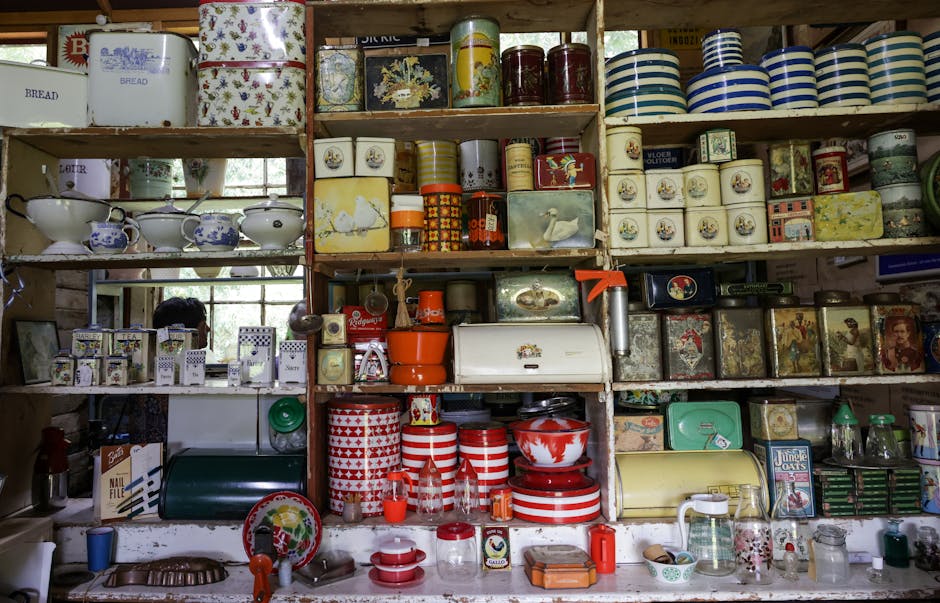
Two years ago, a reseller friend of mine — let's call her Karen — had about $15,000 worth of vintage pottery, glass, and ceramics stored in her finished basement. Roseville, Hull, Weller, a gorgeous collection of Fenton Burmese glass she'd been building inventory on for months. Then a pipe burst while she was on vacation. By the time she got home, three inches of standing water had wiped out nearly everything on the lower shelves. She filed a claim on her homeowner's insurance and got a very unpleasant surprise: her policy covered personal property, not business inventory. The adjuster told her that since the items were being held for resale, they were excluded from her homeowner's coverage. Total payout on $15,000 in inventory: zero.
That story haunts me because I was in the exact same position at the time. I had about $20,000 in inventory stored between my garage, a spare bedroom, and a storage unit, and I had done absolutely nothing to insure any of it beyond my standard homeowner's policy. I assumed I was covered. I wasn't.
Insurance isn't exciting. Nobody gets into reselling because they're passionate about policy riders. But I've talked to enough resellers who've lost significant inventory to theft, fire, flooding, or even car accidents on the way home from estate sales that I think this is one of the most important and most neglected topics in the business.
What Your Homeowner's or Renter's Policy Actually Covers
Let's clear up the biggest misconception first. Your standard homeowner's or renter's insurance policy covers your personal property. That's furniture, clothes, electronics, kitchen stuff — things you own for personal use. The moment an item is designated as business inventory — meaning you bought it with the intent to resell it for profit — it typically falls outside your personal property coverage.
Most standard policies have a "business property" exclusion or a very low sublimit. Some policies will cover up to $2,500 in business property on the premises, which sounds like something until you realize that's your total coverage for all business inventory and equipment combined. If you have more than a couple shelves of inventory, you've already exceeded that.
Here's what makes it worse: many policies also exclude business property stored off-premises. So that storage unit you're renting to hold overflow inventory? Your homeowner's policy almost certainly doesn't cover anything in it. The items in your car on the way back from an estate sale? Probably not covered under your homeowner's policy either.
The "But I Didn't Tell Them It's a Business" Trap
I've heard resellers say "I just won't tell my insurance company it's business inventory." This is a terrible idea for two reasons. First, it's insurance fraud, which is a crime. Second, and more practically, adjusters aren't stupid. If you file a claim for 200 pieces of Pyrex, 50 vintage lamps, and 300 pieces of clothing with tags on them, they're going to figure out it's business inventory pretty quickly. Then you get denied on the claim AND potentially flagged for fraud. Don't do this.
Insurance You Probably Need
Inland Marine Policy (Business Personal Property Floater)
This is the big one for resellers, and it's the policy most people have never heard of. Despite the nautical name, inland marine insurance has nothing to do with boats. It covers movable property — inventory that might be at your home, in a storage unit, in your car, at a flea market booth, or at a show. It follows the property wherever it goes.
For resellers, an inland marine policy typically covers:
- Inventory at your home — garage, spare room, basement, wherever you store it
- Inventory in transit — in your car driving to/from sales or sourcing
- Inventory at off-site locations — storage units, antique mall booths, flea market setups
- Inventory at shows or events — if you do antique shows, this covers your setup
The cost is surprisingly reasonable. I pay about $480/year for $25,000 in coverage with a $500 deductible. That's $40/month to protect $25,000 in inventory. The rate varies based on what you sell (fragile items like glass and pottery cost a bit more to insure), where you store it, and your claims history, but most resellers I know are paying between $300-$800/year for $15,000-$50,000 in coverage.
Some things to watch for when shopping inland marine policies:
- Valuation method: Make sure the policy covers replacement cost or agreed value, not actual cash value. "Actual cash value" means depreciated value, which for vintage items can be absurdly low. A Roseville vase you bought for $40 and can sell for $200 might have an "actual cash value" of $15 according to a depreciation formula. You want coverage based on what the items are actually worth.
- Covered perils: Look for "open peril" or "all risk" coverage, which covers everything except specifically excluded events. "Named peril" policies only cover things explicitly listed (fire, theft, etc.) and tend to have gaps.
- Transit coverage limits: Some policies cap how much is covered while inventory is in your vehicle. If you regularly drive home from auctions with $5,000+ in your car, make sure your transit limit reflects that.
General Liability Insurance
This one's less about protecting your inventory and more about protecting you. General liability covers you if someone gets hurt because of something you sold, or if you cause damage at a location where you're doing business.
Examples where general liability matters:
- A customer claims a vintage lamp you sold had faulty wiring and caused a fire. Whether or not the claim has merit, you need coverage for legal defense.
- You're set up at an antique show and a customer trips over your display and gets hurt. Many show organizers actually require proof of general liability insurance before they'll let you set up.
- You're selling at a flea market and a shelf collapses, damaging a neighboring vendor's merchandise. Your liability policy covers the damage to their property.
A basic general liability policy for a small reselling business typically runs $300-$600/year for $1 million in coverage. If you sell exclusively online and never do in-person events, you might be able to skip this one — but if you do any in-person selling at all, it's worth having. Many antique malls require it to rent booth space, and virtually all antique shows and flea markets require it for vendors.
I bundled my general liability with my inland marine policy through the same insurer and got a discount. Total for both is about $720/year, which works out to $60/month. That's less than the cost of one decent estate sale find per month.
Commercial Auto Coverage (Maybe)
This one depends on your situation. If you use your personal vehicle for sourcing (driving to estate sales, thrift stores, picking up auction wins), your personal auto policy may not cover accidents that happen during business use. However — and this is important — many personal auto policies DO cover incidental business use. You need to read your specific policy or ask your agent.
The risk scenario: you're driving home from an estate sale with $3,000 in inventory in your trunk. You get rear-ended. Your auto insurance covers the car damage, but they might not cover the inventory damage if they determine you were using the vehicle for business purposes. This is where the inland marine policy overlaps — it should cover the inventory in transit regardless of your auto coverage.
Full commercial auto insurance is expensive — often $1,500-$3,000/year more than personal coverage. For most resellers, it's overkill. Instead, talk to your auto insurance agent about adding a "business use" endorsement to your personal policy. This typically costs $100-$300/year and closes the gap without requiring a full commercial policy.
Insurance You Probably Don't Need
Product Liability (For Most Resellers)
Product liability insurance covers you when a product you manufactured or significantly modified causes harm. As a reseller, you're selling items as-is — you didn't make them. General liability typically covers your exposure for selling defective products you didn't manufacture. The exception would be if you're modifying or refurbishing items significantly (rewiring lamps, refinishing furniture with chemicals, etc.). In that case, product liability might be worth discussing with an agent. For most of us selling vintage Pyrex and depression glass, general liability is sufficient.
Business Owner's Policy (BOP) — Unless You're Large
A BOP bundles general liability, business property coverage, and business interruption insurance. It's designed for businesses with a physical commercial location. If you're running your reselling business from home and storage units, a BOP is usually more coverage (and more expensive) than you need. The inland marine + general liability combination covers the same core risks at a lower cost for home-based resellers. If you work from home, you may also qualify for the IRS home office deduction, which can offset some of your operating costs.
That said, if your annual revenue is over $75,000-$100,000 or you have a dedicated commercial space (workshop, warehouse, retail storefront), a BOP starts to make sense. Policies typically run $500-$1,500/year depending on revenue and location.
Cyber Insurance
Unless you're running your own e-commerce website that processes credit cards directly, you probably don't need cyber insurance. If you're selling on eBay, Etsy, Mercari, and Poshmark, those platforms handle payment processing and carry their own cyber liability. If you do run a standalone site through Shopify or similar, the platform provides PCI compliance. Cyber insurance is more relevant for businesses that store customer financial data directly, which most resellers don't.
Documenting Your Inventory for Insurance Purposes
Having insurance is only half the battle. If you need to file a claim, you have to prove what you lost and what it was worth. This is where most resellers who DO have insurance still get burned — they can't document their losses.
What You Need to Maintain
- A current inventory list with purchase prices and estimated market values. If you're using an inventory management system like APMTSales, this is already done — your entire inventory with cost basis and listing prices is in the system. Export it periodically and save a copy somewhere other than your home (cloud storage, email it to yourself, whatever).
- Photos of your inventory and storage areas. Once a quarter, do a walkthrough of everywhere you store inventory and take photos. Wide shots of shelving areas and close-ups of higher-value items. This takes 15 minutes and can mean the difference between a paid claim and a denied one.
- Receipts for purchases. I know this is hard for garage sale and flea market buys. At minimum, keep a log: "June 14 garage sale, 123 Main St, purchased 12 items, $45 total." For estate sales and auctions, keep the actual receipts.
- A backup of your sales records. Your selling platform histories serve as proof of the types and values of items you deal in. If you can show a year of sales averaging $85 per Roseville vase, and you claim 10 Roseville vases were destroyed, the adjuster has a basis for the valuation.
The Photo Inventory Trick
Here's something I do that my insurance agent actually recommended: every time I acquire a batch of new inventory, I photograph everything together with that day's newspaper visible in the frame. It's old-school, but it creates a timestamped record of what you had and when. I also keep a running photo album on my phone specifically for insurance documentation. When I sell something, I delete it from the album. What's left is always a roughly current picture of my unsold inventory.
When to Get Coverage: The Dollar Threshold
Not every reseller needs insurance right away. If you're selling casually — moving $200-$300/month in items you source for a few bucks each — the cost of insurance might not make financial sense yet. Here's my general guideline:
- Under $3,000 in inventory value at any given time: Your homeowner's/renter's business property sublimit might be enough. Read your policy to confirm, but many cover $2,500 on-premises. Focus your energy on growing the business.
- $3,000-$10,000 in inventory: You're entering the zone where a loss would genuinely hurt. Start shopping inland marine policies. At this level, expect to pay $200-$400/year.
- $10,000-$25,000 in inventory: Inland marine is a must. Consider adding general liability, especially if you do any in-person selling. Budget $500-$800/year total.
- Over $25,000 in inventory: Full inland marine and general liability at minimum. Review your auto coverage for business use. You're running a real business with real exposure — insure it like one. Budget $700-$1,200/year.
Where to Get These Policies
Your existing homeowner's or auto insurance company is a reasonable starting point. The National Association of Insurance Commissioners (NAIC) provides consumer guides to help you understand policy types. — ask your agent about adding an inland marine rider or a business property floater. They already have your information and may offer a multi-policy discount.
Beyond that, a few options that resellers commonly use:
- Jewelers Mutual — despite the name, they insure all kinds of collectibles and antiques dealer inventory, not just jewelry. Very familiar with reseller needs.
- Collectibles Insurance Services — specifically designed for collectors and dealers. They understand that a 1940s Roseville Bushberry vase is worth $400 and won't try to depreciate it to $20.
- NEXT Insurance — popular with small businesses, offers general liability and inland marine bundles online. Quick quotes, decent rates.
- Your state's antique dealer association — many offer group insurance rates for members. Annual membership is usually $50-$100 and the insurance discount often more than covers it.
The Bottom Line in Dollar Terms
I pay $720/year total for inland marine ($25,000 coverage) and general liability ($1 million coverage). That's $60/month. In exchange, I know that if my garage catches fire, if my storage unit gets broken into, if a pipe bursts in my house, or if someone trips at my booth at the antique show, I'm covered.
Last year I sold about $52,000 worth of inventory. That $720 insurance cost represents 1.4% of my revenue. By comparison, I spent 18% on platform fees, 8% on shipping, and 3% on packing materials. Insurance is the cheapest operational cost in my entire business, and it's the one that prevents a single bad day from wiping out a year of work.
Karen, from the opening of this article, has insurance now. She rebuilt her inventory over about eight months, got a proper inland marine policy, and moved all her valuable pieces off the basement floor onto higher shelving. She told me the $380/year she pays for insurance is the best money she spends in her business — not because of what it gives her, but because of the catastrophic loss it prevents.
Take 30 minutes this week. Pull out your homeowner's or renter's policy and look for the business property exclusion. Check what your sublimit is. Then get a quote on an inland marine policy. The information alone is free, and it might be the most important half hour you spend on your business this year.